


Why we are building Hive
ARM infrastructure has quietly matured.
What started as hobby boards and experimental clusters is now running real workloads: Kubernetes, self-hosted platforms, CI runners, edge deployments, distributed services, internal tooling. Raspberry Pi Compute Module 5 pushed that transition even further. The compute is no longer the limitation.
But the hardware ecosystem around it still feels improvised.
Too many ARM clusters are still assembled from loose boards, exposed wiring, stacked hats, fragile storage and parts that were never really designed to work together as a long-term system. They work — until they need to scale, move, evolve or simply be maintained.
That gap is what led us to build Hive. Not another Raspberry Pi cluster. A modular compute system designed more like real infrastructure.
Hot-swappable compute nodes. Shared power and connectivity through a custom backplane. Modular storage. Rack-compatible formats. A system that grows from a desktop homelab into a serious multi-node deployment without replacing the hardware underneath.
We’re not approaching this as a startup experimenting with hardware for the first time. blackdevice is a hardware engineering company. We design electronics, firmware and connected devices deployed in real-world environments, and we’re an Official Raspberry Pi Design Partner. Hive comes from years of iteration, prototyping and infrastructure thinking, not from trying to turn a weekend project into a product.
And after working with ARM systems for years, we kept arriving at the same conclusion:
The future of low-power infrastructure already exists. What’s missing is a better way to package it.
ARM infrastructure has changed
A few years ago, ARM infrastructure still felt niche. You could build interesting things with it, but there were obvious compromises everywhere: limited performance, unreliable storage, inconsistent software support and workloads that quickly hit practical ceilings. Most Raspberry Pi clusters existed either as educational projects or highly customized setups maintained by enthusiasts willing to tolerate friction.
That landscape has changed dramatically. Modern ARM platforms are now capable of running workloads that previously required far larger and more power-hungry systems. Lightweight virtualization, Kubernetes distributions like K3s, containerized services, CI pipelines, monitoring stacks, private cloud platforms and self-hosted applications all run comfortably on ARM today.
At the same time, the economics of infrastructure have changed too. Power efficiency matters more. Owning infrastructure matters more. Running services locally increasingly makes sense again — whether for privacy, latency, operational cost or simple control over the stack. That shift is happening simultaneously across several worlds:
- homelabs
- self-hosting
- small business infrastructure
- industrial edge deployments
- and distributed compute environments
The Raspberry Pi CM5 accelerated that transition even further. For the first time, the Compute Module ecosystem feels capable of supporting infrastructure that is not just experimental, but operationally serious. Enough compute density, enough memory, proper NVMe storage support, mature networking and an ecosystem large enough to sustain long-term deployments.
The problem is that most of the surrounding hardware still hasn’t caught up. And that’s where we believed there was room to build something different.
But most ARM clusters still feel experimental
The hardware itself improved faster than the systems around it. That is especially visible in the Raspberry Pi ecosystem. There are countless impressive DIY clusters online, and many of them genuinely work well. But once you move beyond experimentation and start treating infrastructure as something that needs to run continuously, evolve over time and remain maintainable, the limitations become obvious very quickly.
Cables everywhere. External SSDs attached one by one. Stacked boards with inconsistent thermals. Power delivery handled through layers of adapters. Nodes that are easy to assemble once, but difficult to service later. Storage distributed across improvised solutions. Hardware scaling that often means rebuilding the entire setup from scratch.
Most clusters are designed to be built. Very few are designed to be operated. That distinction matters, because the moment infrastructure becomes useful, it also becomes something you depend on. And once people depend on a system, maintainability starts mattering just as much as raw performance.
Replacing a failed node should not require disassembling half the system. Expanding compute capacity should not mean redesigning the architecture.
Storage should not become an afterthought hanging from USB cables. A homelab should not become harder to manage simply because it became successful.
We kept seeing the same pattern repeatedly: people were building increasingly serious ARM infrastructure on top of hardware ecosystems that still behaved like prototypes.
At the same time, the audience itself was changing. Homelabs are no longer just hobby environments. They are becoming learning platforms, staging environments, private cloud infrastructure, self-hosted production systems and development platforms. Small businesses are deploying lightweight ARM systems for internal services, monitoring, automation and edge workloads. Developers increasingly want infrastructure they actually own and understand.
But between DIY clusters and enterprise hardware, there is still a surprisingly large gap. That gap became the starting point for Hive.
We wanted something closer to real infrastructure
Hive started with a simple idea: What would ARM infrastructure look like if it were designed as a cohesive system from the beginning instead of assembled from independent parts?
Not just a group of boards connected together. An actual modular compute platform.
That decision shaped almost everything that came afterwards. Instead of treating each node as an isolated device with its own external power supply, disconnected storage and exposed cabling, we designed a shared system architecture around hot-swappable compute modules connected through a custom backplane.
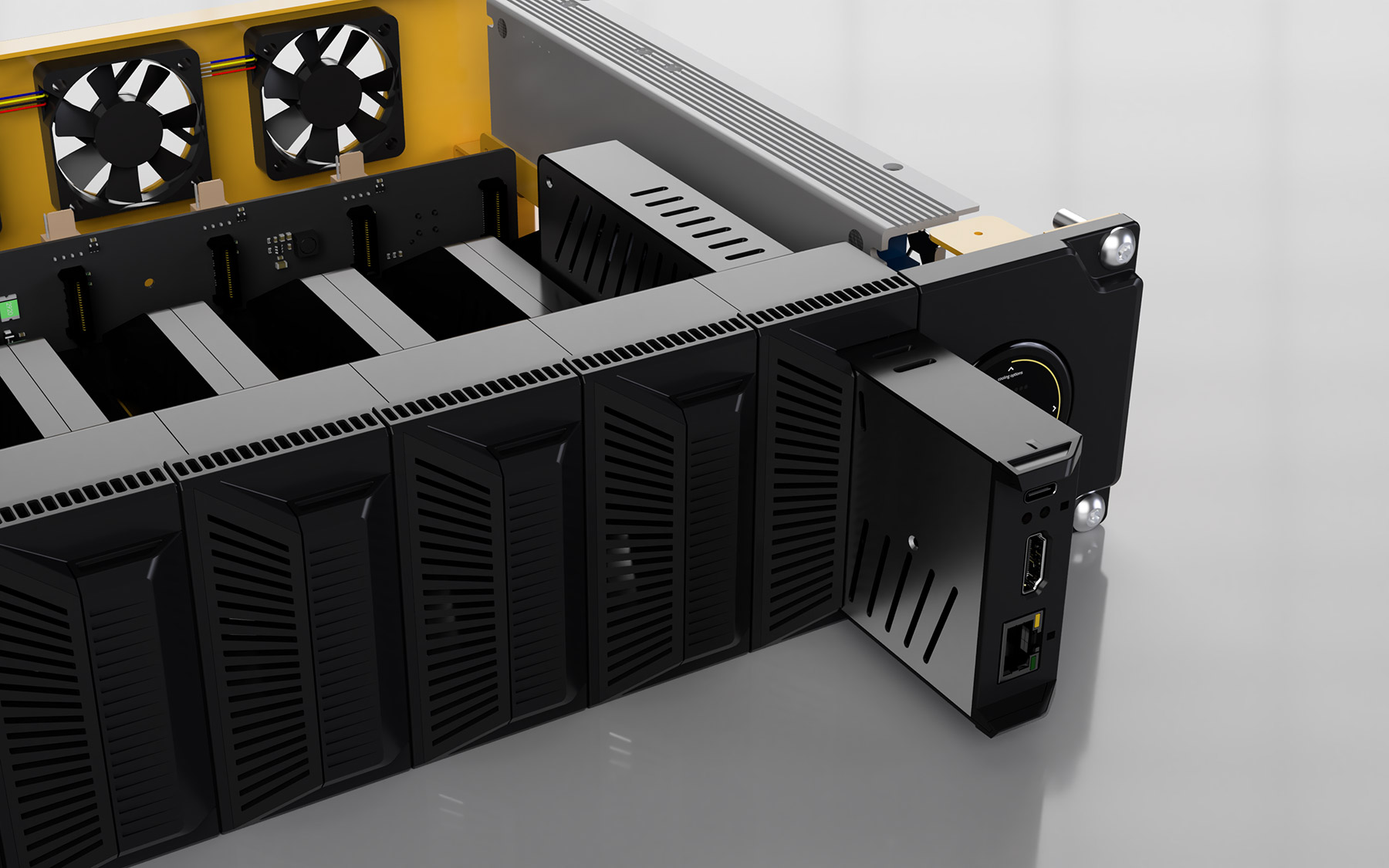
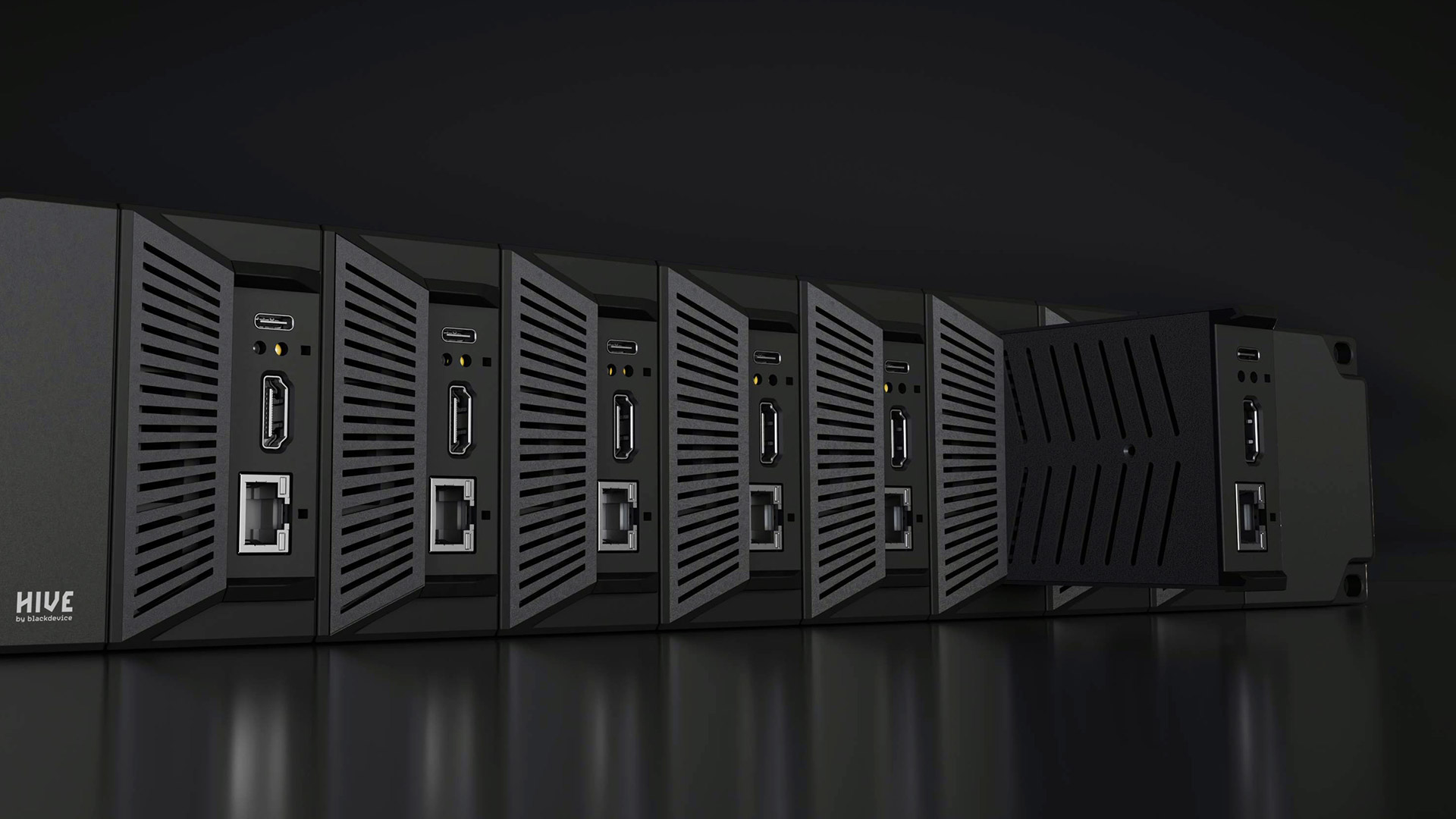
Each beenode acts as an independent compute unit built around Raspberry Pi CM5, with its own storage and front-accessible connectivity. But once inserted into Hive, the nodes become part of a larger infrastructure system that shares power delivery, mechanical structure and internal connectivity.
The goal was not to remove flexibility. The goal was to remove friction.
We wanted nodes that could slide in and out in seconds. A system that could scale gradually instead of forcing users into fixed hardware decisions. Something compact enough for a desktop homelab, but structured enough to live inside a rack and run continuously.
That is why Hive exists in two formats from the start.
Hive Mini is designed as the entry point: a compact four-node system for homelabs, self-hosting and experimentation. The full Hive expands the same ecosystem into an 8-node 2U rack-mounted platform aimed at more serious infrastructure workloads.
But the important part is that both systems share the same beenodes. A node purchased for Hive Mini can later move directly into a full Hive chassis without replacing anything. The hardware evolves with the user instead of becoming obsolete the moment requirements change.
That modularity became one of the core principles behind the entire project. Not because modularity sounds good in marketing copy. Because infrastructure rarely stays static for long.
At its core, Hive is designed as a modular ARM infrastructure platform that can scale from compact self-hosted setups to larger multi-node deployments without changing ecosystems. Here’s the system at a glance:
| Feature | Hive |
|---|---|
| Compute platform | Raspberry Pi CM5 |
| Architecture | Modular hot-swappable bee nodes |
| Node count | Up to 8 nodes |
| Storage | NVMe per node |
| Connectivity | Shared custom backplane |
| Formats | Hive Mini + Hive |
| Deployment targets | Homelab, self-hosting, edge, SMB |
| Form factors | Desktop / 10″ mini rack / 19″ 2U rack |
| Scalability | Shared node ecosystem across formats |
Why modularity matters
Infrastructure changes constantly. That is true in enterprise environments, but it is increasingly true for homelabs and self-hosted systems as well.
A small Kubernetes setup becomes a larger distributed environment. Local NAS evolves into a private cloud. A few self-hosted services turn into monitoring stacks, CI runners, VPN gateways, automation systems and internal tooling. What starts as experimentation often becomes infrastructure people rely on every day.
Most small ARM systems are not designed for that kind of evolution. They are designed around a fixed configuration assembled at a specific moment in time. Expanding them later usually means replacing hardware, redesigning layouts or rebuilding the cluster entirely.
We wanted Hive to behave differently.
The beenode became the foundation for that idea. Each node is a self-contained compute module with its own CM5 carrier board, NVMe storage and front-accessible ports. It can operate independently, but it also integrates into a larger modular system through the backplane architecture.
That separation matters because it changes how the infrastructure evolves over time.
Need more compute capacity? Add nodes.
Need to replace or upgrade a node? Swap it in seconds.
Need to move from a desktop homelab into a rack-mounted deployment? The same nodes continue working inside the larger system.
The hardware investment does not reset every time the infrastructure grows.
That may sound simple, but it fundamentally changes how people approach ARM deployments. Instead of treating the system as a disposable experiment, it becomes something incremental and long-term — closer to how real infrastructure behaves.
The hot-swappable architecture was also important for another reason: operational simplicity. One of the problems with many DIY clusters is that maintenance quickly becomes uncomfortable. Accessing a single board can involve disconnecting cables, removing layers of hardware or partially dismantling the entire setup. The more successful the system becomes, the more fragile maintenance starts to feel.
We wanted the opposite experience. A node should be removable from the front. Storage should feel integrated into the system instead of attached afterwards. Airflow should be intentional. Power distribution should be centralized. The physical architecture should reduce complexity instead of adding more of it.
A lot of the engineering work behind Hive was not about maximizing benchmark numbers. It was about making ARM infrastructure easier to live with over time.

Designed for homelabs. Built with production experience.
One of the things we noticed early during development is that the line between “homelab” and “real infrastructure” is becoming increasingly blurred. The same person running containers at home today may later deploy services professionally.
A self-hosted environment used for learning often becomes a staging environment, a remote edge deployment or the foundation for production tooling. Small businesses are also adopting lightweight ARM infrastructure for workloads that do not justify large traditional servers.
But despite that overlap, the hardware worlds around those users still feel disconnected. DIY systems often prioritize experimentation over long-term maintainability. Enterprise systems prioritize scale and standardization, but usually at costs and complexity levels that make little sense for smaller deployments.
Hive was designed somewhere in between those two worlds. Compact enough for a desktop setup. Structured enough for rack infrastructure. Flexible enough for experimentation. Stable enough for long-term deployment.
That balance also influenced the industrial design. The mechanical rail system developed together with Weetbe was not only about aesthetics. It became part of the operational philosophy of the product: nodes that insert cleanly, align correctly and guide airflow through the chassis as part of a coherent physical system.
The same applies to the front-access architecture, the modular storage layout and the shared backplane design. The intention was always to make the infrastructure feel deliberate instead of improvised.
Because once infrastructure disappears into daily use, good design stops drawing attention to itself. It simply works.
Built by a hardware engineering company
Hive did not start as a content project, or a speculative render. It came from years of working with real hardware systems.
blackdevice is a hardware engineering company. We design and develop electronics, firmware and connected devices deployed across real-world environments and international markets.
Manufacturing, certification, industrialization and long-term product development are part of our normal workflow — not something we are learning for the first time through this project.
That background shaped the way Hive was developed from the beginning.
Electronics were designed and assembled in-house. Our CM5 carrier architecture was designed in-house.
Mechanical system and modular rail structure were developed specifically for this product together with Weetbe, our industrial design partner. The system was iterated as hardware, not just visual concept art.
A lot of modern hardware launches happen in reverse:
- first the marketing
- then the render
- then the promise that the engineering will somehow follow later
We deliberately avoided that approach.
Hive has been evolving internally for years
Prototype systems already exist and have been tested in real operational environments through ipglobal’s infrastructure team. That process has been extremely valuable because infrastructure behaves very differently once it starts running continuously under real workloads instead of controlled demonstrations.
Being an Official Raspberry Pi Design Partner also gave us a very direct perspective on where the CM5 ecosystem was heading.
We have worked with Raspberry Pi hardware long enough to see a clear shift happening:
ARM systems are no longer limited to education or experimentation. They are becoming viable infrastructure platforms for an increasing number of workloads.
But we also felt the ecosystem still lacked hardware designed around operational continuity:
- maintainability
- serviceability
- modularity
- thermal consistency
- deployment flexibility
Hive became our answer to that problem. Not because the world needed another cluster. Because we believed ARM infrastructure deserved better systems around it.
Why we’re launching Hive on Kickstarter
Hive is still an ambitious hardware project. Launching through Kickstarter allows us to bring the platform directly to the people who understand it best: homelab builders, self-hosters, developers, sysadmins and infrastructure enthusiasts who actively want alternatives to traditional infrastructure models.
More importantly, it allows us to build the ecosystem together with the community around it.
One of the reasons Hive exists in two formats — Hive Mini and the full rack-mounted Hive — is because we know people enter infrastructure at very different scales. Some want a compact desktop homelab. Others want modular ARM infrastructure for larger deployments. The shared bee node ecosystem allows both paths to grow together instead of fragmenting into separate products.
Crowdfunding also creates something traditional hardware launches often lack:
direct feedback loops between builders and users.
That matters to us.
Hive is not intended to be a closed appliance with a fixed audience. It is a modular infrastructure platform, and platforms become stronger when the community around them helps shape how they evolve.
The goal is not simply to launch a product. The goal is to build a long-term ecosystem around modular ARM infrastructure that feels serious, maintainable and genuinely useful to operate.
Because after years of working around the limitations of improvised ARM systems, we think the infrastructure itself deserves to evolve too.
And that is why we are building Hive.
Hive is currently in active development ahead of our Kickstarter launch
We’ll be sharing engineering updates, prototype iterations, infrastructure experiments and behind-the-scenes progress as the system continues to evolve.
If you want to follow the project — or get access to the early-bird launch when the campaign goes live — you can join the waitlist here:
→ hive.blackdevice.com
No spam. Just real progress as we build.
Hive is launching on Kickstarter. Are you in?
Get on the early bird list and get exclusive access before anyone else
You’ll receive a confirmation email. Please check your spam folder if you don’t see it.
What you’ll get: project updates as we build – launch alert the moment it’s live – your exclusive early bird link. No spam. Leave anytime.