

Why it matters
Customers feel the result. Your business sees the data
A better in-store experience
Lights fade up on entry, signage shows which cabins are free. No switches, no guessing, no friction.
Automation and energy savings
Lighting responds to real occupancy. Empty cabins don’t burn energy: measurable savings, month after month.
Remote management
Firmware updates, health monitoring, diagnostics and incident resolution: without a site visit.
Data for real decisions
Occupancy, peak hours, session times, utilization per cabin, zone and store: objective input for planning.
How a cabin works
From presence to action, in under a second
Customer enters: cabin OCCUPIED
- Cabin and mirror lighting fade up gradually
- Exterior indicator switches from free to occupied
- RFID reader or other external equipment is activated
- Occupancy event is published in real time
- Session start is logged for later analytics
Customer leaves: cabin FREE
- Lighting dims down or switches to courtesy level
- Exterior signage returns to available
- RFID reading stops, where integrated
- Free event is published to the platform
- Session duration is recorded
Switch-on and switch-off delays, presence confirmation times, dimming curves and courtesy levels are all configurable per store format.
Privacy by design
No cameras. No images. No identity data
Detection uses UWB radar: presence and distance only, without capturing images or identifying individuals, and sensitive enough to maintain reliable detection even when the occupant remains completely still.
Designed to minimize data collection from the hardware level up, supporting privacy-first, GDPR-conscious deployments in one of retail's most sensitive spaces.
UWB Radar detects presence and distance: nothing else
0 img No cameras or image data anywhere in the system
GDPR Privacy-first architecture that supports GDPR compliance by design
Hidden Sensors install behind panels: customers never see the hardware
Installation
Built to be invisible
The entire system: sensor, cabling and gateway: installs during store fit-out, hidden inside the cabin structure behind panels and claddings. For selected existing store formats, a project-specific plug & play configuration minimizes or avoids structural work. Customer feel the result; they never see the hardware.

Inside the cabin. The sensor sits hidden behind the panel: front or side installation: controlling the mirror light, ceiling lights and the exterior occupancy flag.
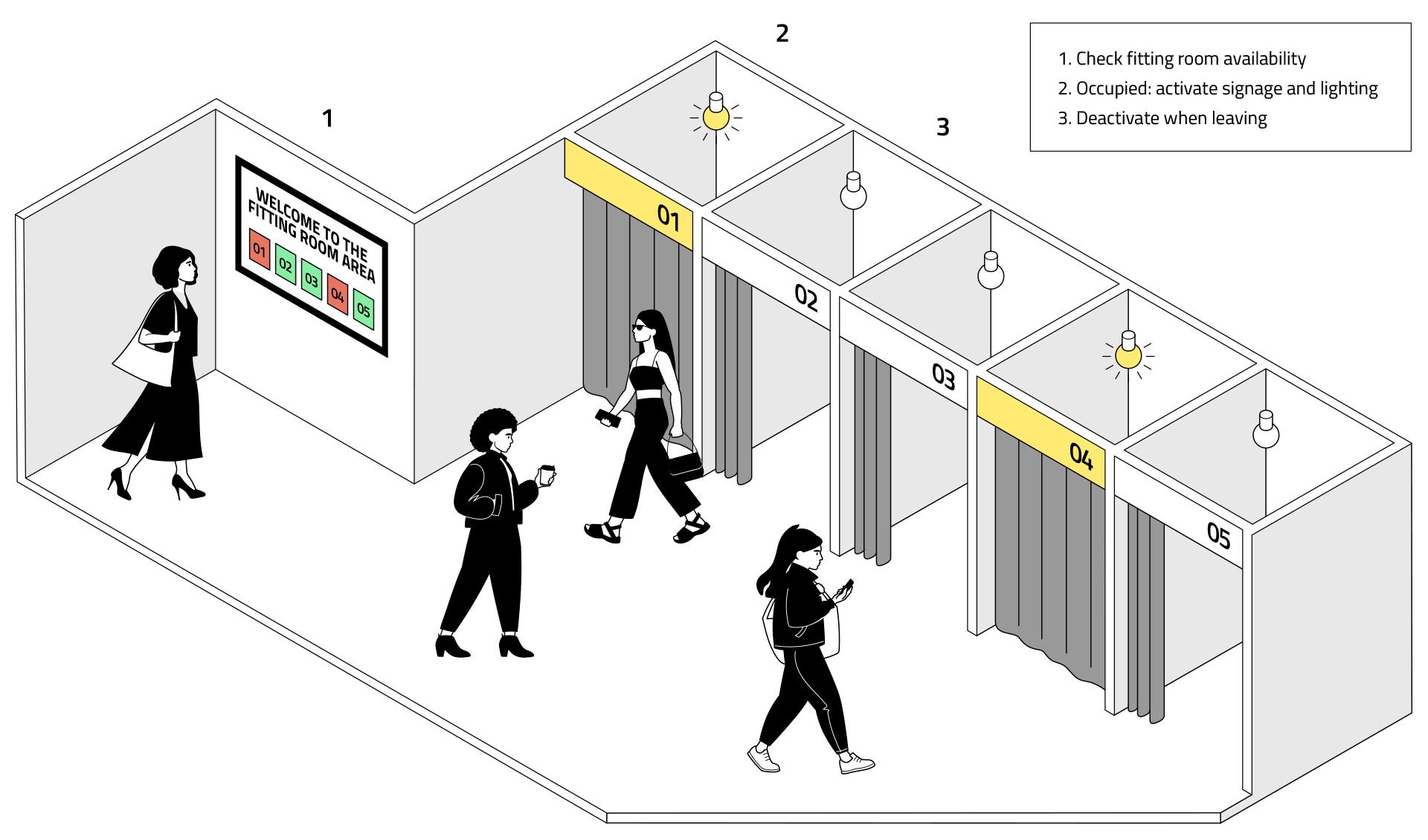
On the floor. LED flags show at a glance which cabins are free or occupied: white on/off or full RGB to match your brand.

End to end. From presence detection in the cabin, through the gateway in the store rack, to the Retail Insight Platform: lights, signage and data, all in under a second.
The system
Two devices. One complete system

BD-IOT-SENS
Presence sensor & cabin controller
One per cabin, hidden behind the panel. Far more than a detector: a full I/O module that drives the cabin: mirror and ambient lighting, occupied/free indicators, RGB elements, auxiliary equipment via relay, 0-10V dimming, and external systems such as RFID readers. Two sensors can be chained in one cabin for large or accessible rooms.
- UWB radar: movement + distance · concealed behind common non-metallic panels
- NC/NO relay · 2x 0-10V dimmers · 24VDC aux · 3x RGB outputs
- BUS in/out over RJ45 · 9-position sensitivity adjustment
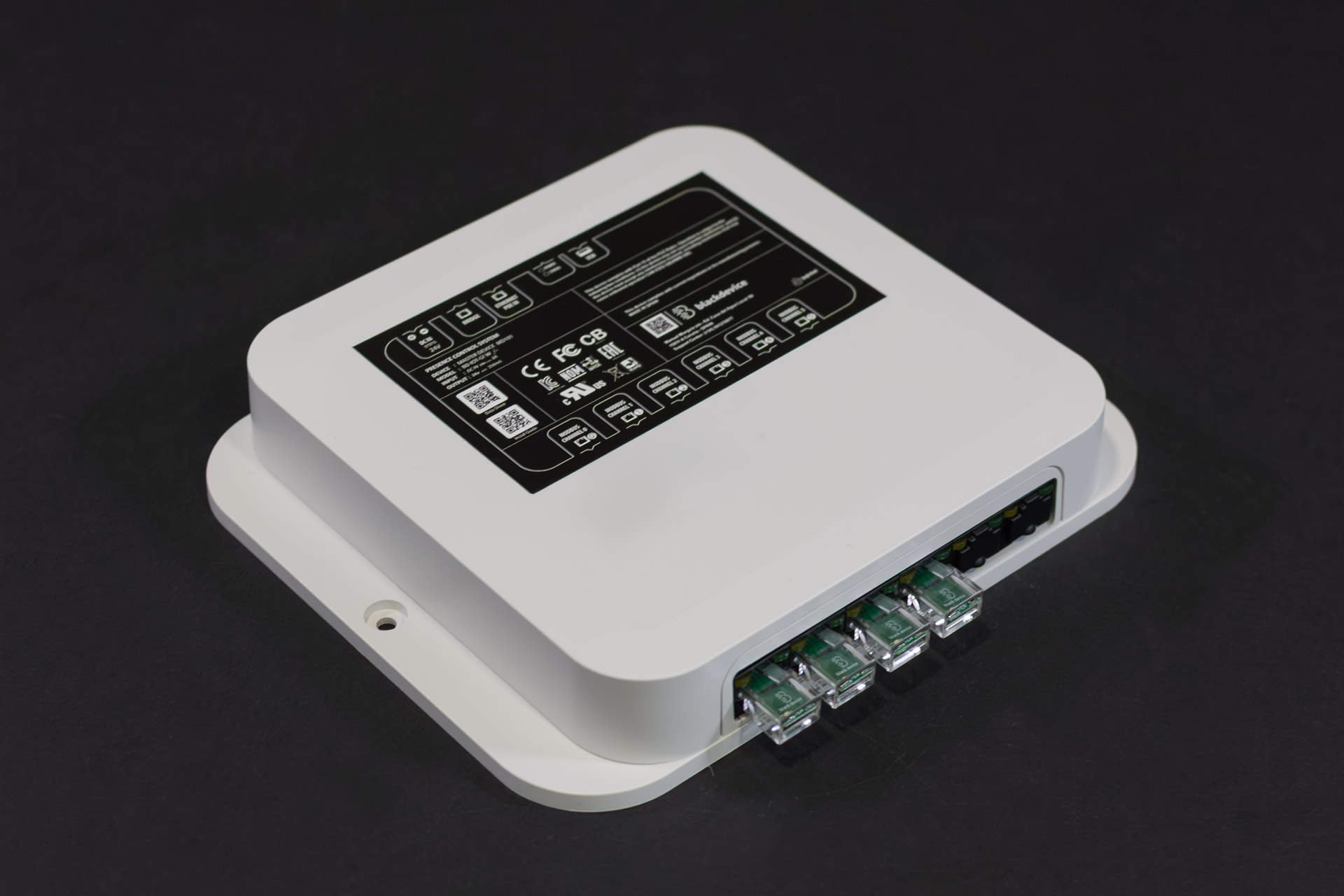
BD-IOT-GTW
Gateway & central controller
Installed in the store’s technical area or communications cabinet, it concentrates all sensors, coordinates lighting and signage, and connects the fitting room floor to the store’s network: publishing real-time events to middleware, dashboards or your own systems, with full remote management.
- 6 independent BUS channels · up to 32 sensors (24 recommended)
- Linux ARM64 · OTA updates · remote reboot via PoE
- Ethernet to store network · MQTT, API and middleware integration
Architecture
One cable. Daisy-chained. Plug & play
Sensors connect in series on a single standard UTP Cat. 6 cable carrying Modbus communication: not an Ethernet network, just one simple wire per line. Each gateway offers six independent BUS channels, so cabins can be grouped by zone, floor or fitting room area.
Connected network
Sensors + gateway + store network. Central management, real-time events, remote diagnostics, firmware updates, analytics and integration via MQTT, API or middleware.
Hybrid
Local, instant activation of RFID or other equipment via a direct physical output: while the gateway still publishes events and keeps analytics, diagnostics and future flexibility.
Standalone
A single sensor triggering external equipment directly, no gateway. Minimal infrastructure for very simple needs: without central management or statistics.
Integration
RFID-ready. Vendor-independent
The system doesn't include RFID readers or antennas: it provides the cabin intelligence that drives them. We detect the start and end of each fitting-room session and use that state to activate your reader: physically, over the network, or both. Compare try-on data with sales by store, region or season.
01 · physical
The sensor delivers a direct electrical signal to the reader: immediate, local, independent of any server connection.
02 · network
The gateway publishes start/stop events via MQTT, TCP/IP, API or your agreed protocol: your middleware subscribes.
03 · hybrid
Local physical activation for zero latency, while the gateway logs and distributes every event centrally.
Retail Insight Platform
Every fitting room becomes a source of intelligence
Usage analytics
Uses per cabin, average session time, occupancy rate, peak hours, weekday patterns: compared across cabins, zones, floors and stores.
Capacity & queue pressure
Are there enough cabins at peak? Which zones saturate on weekends? Estimate demand pressure and probable queues from occupancy, capacity and session length.
Space planning
Spot chronically under-used cabins, recover floor space for merchandising, size fitting room areas for future stores with real data.
AI anomaly detection
Abnormally long occupations, unresponsive sensors, offline gateways, patterns that don’t match store hours: flagged before anyone notices.
Uses today
247
+18% vs last Monday
Avg. session time
6.4min
-0.8 min last week
Peak hour
17:00
38 uses in 1h
Hourly usage

Most used cabins today
Local first, connected second
Detection, lighting, signage and physical activation run locally in the cabin: connectivity adds monitoring, analytics and remote management, but never compromises basic operation.
Technical specifications
Built for intensive retail environments
BD-IOT-SENS · sensor
| Detection | UWB radar · movement + distance · concealed install validated per cabin materials |
| Relay output | NC/NO · 0-240 VAC / 0-60 VDC · 3,15 A |
| Dimming | 2x 0-10 VDC · direct 24 V dimmer for mirror light |
| Aux outputs | 24 VDC 1 A · 3x RGB NPN 1 A · 2x 24 V banner direct |
| Communication | Modbus over UTP · RJ45 in/out · optional 2nd sensor per cabin |
| Power | 24 VDC 2 A external PSU |
| Physical | 150 x 85 x 25 mm · 100 g · 15 to 70 º C · UL 94 V0 enclosure |
BD-IOT-GTW · gateway
| Capacity | Up to 32 sensors (bus ≤ 200 m) · 24 recommended · 6 bus channels |
| CPU | Quad-Core ARM A55 @ 2.0 GHz · 2 GB RAM · 16 GB eMMC · Linux |
| Connectivity | 2x RJ45 Ethernet · 6x differential serial BUS · USB · HDMI |
| Management | OTA updates · remote config · remote reboot · TEST mode |
| Power | PoE and/or external 24 VDC 3 A · supply backup between both |
| Physical | 180 x 150 x 35 mm · 190 g · 15 to 70 º C · UL 94 V0 enclosure |
| Certifications | CE · FCC · UL · RoHS · IEC 62368-1 · ETSI EN 301 489 |
Working together
From cabin design to live operation
We don't just supply devices. We join projects from the earliest design phases: so architectural decisions never compromise detection, cabling, lighting or RFID integration later on.
phase 1
Information
Plans, photos, materials, cabin count, lighting & network requirements
phase 2
Technical review
Sensor positions, gateways, BUS layout, cabling, integrations, risks
phase 3
Pilot
Representative cabins validate detection, isolation, lighting & RFID
phase 4
Engineering
Installation drawings, BOM, electrical schematics, network design
phase 5
Deployment
Installation, calibration, cabin mapping, platform onboarding
phase 6
Operation
Monitoring, remote maintenance, updates, data analysis
What we need to prepare your proposal
Send us what you have: we’ll guide you through the rest.
Space
Number of cabins & floors · dimensions · plans & photos · panel materials · mirrors & metal structures
Electrical
Luminaire types & drivers · 0-10 V compatibility · RGB needs · desired lighting behaviour
Network
Ethernet/PoE availability · VLAN & IP policy · firewall rules · MQTT/API access · security requirements
RFID (if any)
Reader make & model · GPIO specs · middleware · antenna layout · expected start/stop logic