

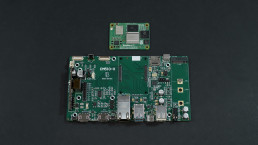
The ioX is a professional-grade carrier board designed and manufactured by blackdevice for the Raspberry Pi CM 5. Sharing the same compact footprint as the official IO board, it adds PoE+, dual HDMI, dual DSI, 3.5mm audio, M.2 NVMe storage, and a flexible GPIO expansion header — all in a single board built for real-world industrial and commercial deployments.
year2026serviceshardware design & engineering, electronics, prototyping, PCB assembly
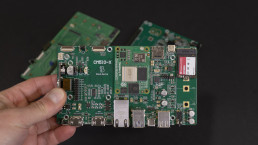
The ioX is a professional-grade carrier board engineered around the Raspberry Pi Compute Module 5. Designed and manufactured by blackdevice for demanding real-world deployments. From industrial automation to digital signage and edge computing, it packs an exceptional feature set into the same compact footprint as Raspberry Pi’s IO board, making it compatible with standard CM5 enclosures while going significantly further in capability.
Whether you’re building a ruggedized kiosk, a network appliance, or a custom embedded system for a client installation, the ioX gives you the connectivity, power flexibility, and expansion headroom to do it right.
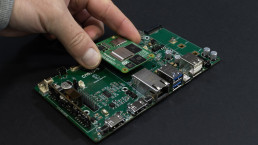
Most CM5 carrier boards force a trade-off: either they’re too bare-bones for production use, or they’re overbuilt for the application at hand. The ioX was designed to hit a precise sweet spot — dense connectivity, industrial-grade power input via PoE+, and thoughtful expansion options, all without inflating the board size beyond the standard IO board footprint.
The integrated PoE+ module (up to 30W) means the board can be powered entirely over the network cable in rack or wall-mount deployments, eliminating the need for a separate power supply run. PoE backward compatibility ensures it works with existing PoE infrastructure, delivering up to 12W on standard PoE switches.
Audio output via the 3.5mm jack opens the door to kiosk, signage, and interactive display applications. Dual HDMI outputs and two DSI connectors support multi-display configurations. The auxiliary GPIO header breaks out I²C, SPI, UART, PWM, and additional USB 2.0 lines, giving hardware teams a clean interface point for custom shields and expansion boards tailored to specific project needs.
Remote management was a first-class consideration: the proprietary POE Reset feature allows a board deployed in a remote installation to be restarted simply by toggling PoE off and on from the switch’s web interface — no physical access required, even if the board is also powered via USB.
Connectivity
Expansion
Controls
Form Factor
Compute Modules
Storage
Cooling
Power
Expansion via GPIO Header
| Feature | Detail |
|---|---|
| Compatible modules | CM5, CM5 Lite (limited CM4) |
| HDMI outputs | 2× (HDMI0, HDMI1) |
| DSI connectors | 2× (DSI0, DSI1) |
| Ethernet | 1× Gigabit, PoE+ (802.3at / 30W) |
| USB 3.2 Type-A | 2× (1.5A per port) |
| USB 2.0 Type-A | 2× (500mA per port) |
| USB-C | 2× (front: data + power; rear: power only) |
| Audio | 3.5mm stereo jack |
| Storage expansion | M.2 Key M + microSD (CM5 Lite) |
| GPIO header | 2×10 pins (PWM, SPI, I²C, UART, USB 2.0) |
| Remote reset | POE Reset (jumper-enabled) |
| RTC | Battery connector (3V coin cell) |
| Fan | 4-pin, Active Cooler compatible |
| Jumpers | Wi-Fi disable, BT disable, EEPROM WP |
| Form factor | Raspberry Pi CM5 IO board footprint |
| Power input | USB-C 5V/5A or PoE/PoE+ |
If you’re deploying Compute Module 5 in a professional or industrial context, the CM5 IOX removes the compromises that come with generic carrier boards. It was designed for real installations — where remote manageability, power-over-Ethernet, and expansion flexibility aren’t nice-to-haves, they’re requirements. The board is produced to the same standard we use internally for client projects, which means it has been stress-tested in conditions that matter. The standard CM5 IO board footprint means no custom enclosure work for most deployments, and the auxiliary GPIO header is your clean path to whatever project-specific hardware interface your application demands.
For volume orders, we can discuss lead times, configuration variants (with or without rear USB-C, for example), and custom GPIO shield design as part of the engagement.